Four Catamaran Buoys for Duqm, Oman
When BlueWater Energy Systems was awarded the contract to deliver a Catenary Buoy Mooring (CBM) system for the ACME Green Ammonia export terminal in Duqm, Oman, the project called for Resinex support, as it would be the first facility of its kind in the world, designed to export refrigerated green ammonia produced entirely from solar power.
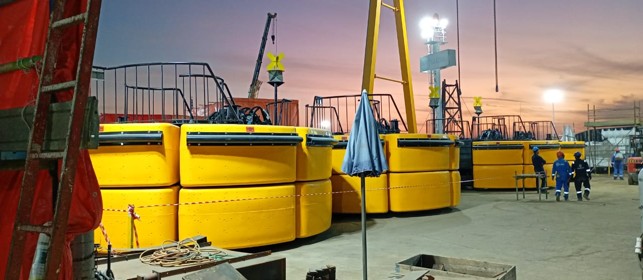
For a terminal of this significance, the mooring infrastructure had to match the ambition of the project. BlueWater turned to Resinex for the supply of four PEM 58 x 2000 catamaran buoys, each engineered to handle mooring loads of up to 200 tons SWL, and a load test at MBL (Minimum Breaking Load) of 300 tons.
A buoy that always stays balanced
The catamaran buoy is one of Resinex’s most technically refined products: unlike a conventional mooring buoy, which tends to tilt under lateral load, Resinex’s own catamaran design incorporates a lever-based balancing system that keeps the buoy horizontal even under the most demanding mooring conditions.
The result is a platform that is more stable, more predictable in its behavior, and better suited to the harsh conditions of an offshore mooring infrastructure.
Built to last
Each buoy is built from 16+2 modular floats filled with polyurethane foam, a construction that ensures permanent buoyancy and eliminates the need for maintenance over the buoy’s service life.
The buoys are also equipped with a double quick-release hook rated at 2 x 100 tons with a remote release system, a load cell monitoring system, a radar reflector, safety guardrails, access ladders, and fittings for a marine lantern and foghorn.
From testing to delivery
In January 2026, two Resinex technicians travelled to Ras al Khaimah to oversee the assembly of the four catamaran buoys, ensuring that each unit met the required specifications before delivery on site.
The Duqm terminal is scheduled to begin operations in 2027, supplying green ammonia to dedicated tankers, representing a significant step in the transition toward clean energy shipping infrastructure.
Resinex’s involvement in this project is a reminder that mooring, pipe deployment, signaling and data collection may not feature in the energy transition discussion, but without reliable, well-engineered buoy systems, clean energy could not make its way from the source to the ship, and from there, to the homes of the people who use it.